

Anthropic on track for $20 billion annual revenue, up from $14 billion “a few weeks ago”: BBG
On a pretty bleak day in the markets, one might draw comfort from Dario Amodei’s bullishness at the MS TMT conference yesterday.
Here he echoes what we have been saying for a while - exponential growth often catches people off guard:
“We do not see hitting the wall. I think this year is going to have a radical acceleration that surprises everyone. Exponentials catch people off guard — there’s the old parable of the second half of the chessboard, where you have one grain of rice in the first square, two on the second, four on the fourth. By the time you get to the 64th square, you have billions or trillions of grains of rice. We’re standing on square 40 out of 64, and from square 40 to square 64, it’s going to go faster than you think — even having seen how fast it’s gone so far. I don’t think people are ready for it. I think we are on the precipice of something incredible.”
Billionaire in Singapore buys 1 million Nvidia shares: X
Says he will buy another million to show support.
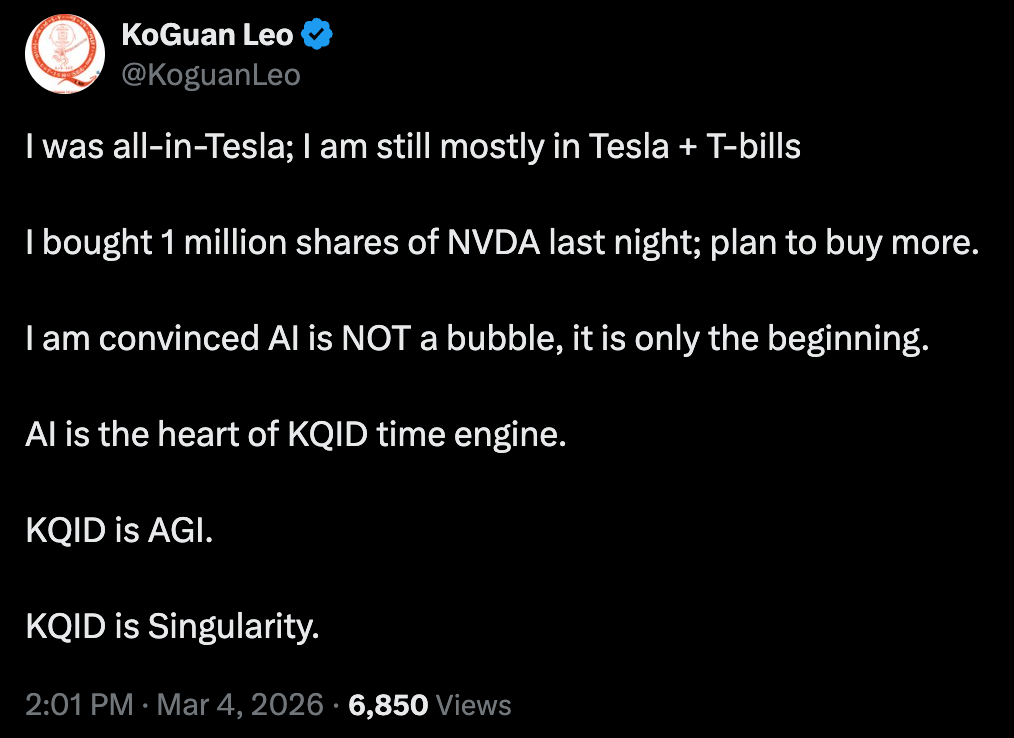
With the Koreans out for the count, guess we all have to chip in whatever way we can.
Teradyne: Bullish on test equipment, and by extension consumables
We also have bullish comments from Teradyne, relevant to both Teradyne and Japan Electronic Materials.
I must take objection to being called exuberant on X because this CEO just called test intensity “crazy high”. This seems like a big change of tone from the earnings call, which was a damp squib.
And so what we're seeing right now is a massive increase in the capital intensity associated with AI compute. And that's in the memory space and in the SOC space.
…
So if you look at the test intensity as like a ratio of the device COGS, it's a much larger increase because so much of the money that's being made in memory is on ASP increase and so much of the money that's being made in the AI accelerator space is on the high margin in those devices. So it's actually -- like it's crazy, high increase in test intensity.
The persistence of demand for consumables is implied by his “2027 and beyond” comment below. He also notes that the CPO tailwind for Teradyne is the next wave, which was the main reason why we bought in during the earnings call dip.
Shane Brett
If I were to be a bit of a pessimist and say, 2026, super high semi test intensity. ‘26, we may see a digestion. Your kind of rebuttal will be there’s a much broadening of the customers. AI revenue seems to have a little bit more durability and longevity. These kind of CapEx plans are kind of spread through years.
Gregory Smith
So I feel like there’s waves in the AI space. So in 2025 and into 2026, most of the growth in memory is really revenue growth driven by ASP increase. Like more people are chasing after the same number of parts. We are not seeing -- we’re seeing very good, healthy TAMs, but we haven’t seen the impact of significant capacity increases in memory. That’s more of a ‘27 and beyond thing.
We are seeing significant growth in AI accelerator and in networking, but none of that incorporates the complexity and the TAM expansion that we would expect to see from the introduction of co-packaged optics for scale out and scale up. Those are things that are likely to like be the next waves falling on the shore.
Seikoh Giken and Santec
The morning started with a remarkable appetite for these shares, with both green momentarily while the rest of Nikkei sold off.
The good news is that there are folks who think Seikoh Giken is worth 28.5k a share in the middle of a war.
Quote in Nikkei Asia today offers some support for that exuberance:
An executive with an optical module supplier serving Nvidia and Amazon Web Services said supply crunch concerns are growing. "Not just the large chips but also some small chips related to AI are in short supply, and we are very worried about it, as it will affect the smoothness of our shipment to end customers," the executive said. "Those small, overlooked chips and components not only are in constrained supply, but also much more expensive now."
KYEC and ASE capex
The article also notes:
Chip packaging and testing house ASE Technology Holding and chip testing service provider King Yuan Electronics Co. (KYEC) are both planning record spending for 2026.
It is actually remarkably simple to figure out which Taiwanese companies are likely being recommended in SemiAnalysis’ Core Research to institutional clients.
It costs nothing and with a drawdown like this week you may not be particularly late to the party. This hack is no big secret now, having been discussed in the subscriber chat for two days.