

ABF Shortage called out by TSMC at OCP Asia
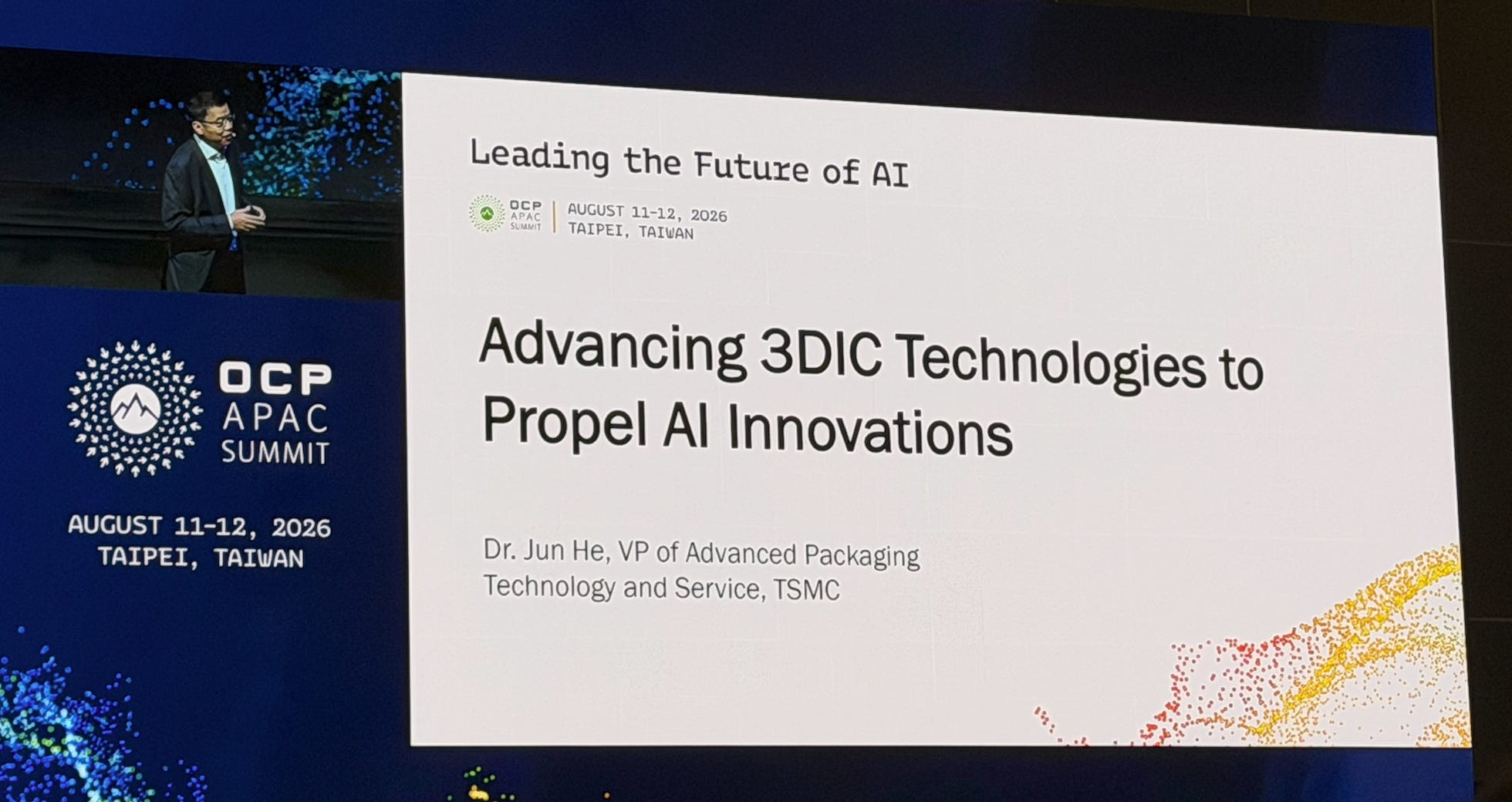
Dr He confirming what we’ve flagged for several months now - memory and ABF are the two most severe shortages in semis:
One of the immediate challenges I see right now, and this is true for the whole industry. In the last couple of years, and for the next few years, the whole industry is facing tremendous shortage, not only on memory, but also on something called ABF substrate. Your sourcing team is knowingly taking risk of multiple sourcing because of the capacity shortage.
Ibiden is a key beneficiary. AT&S is a relatively undervalued player who took more space in Kulim last week to support a growing workforce. AT&S is one of our favourite ideas.
Singapore raises GDP growth forecast to 4.5 to 5.5% (PR)
Ministry of Trade and Industry:
[A]cceleration in global AI-related capital expenditure should boost growth in the electronics and precision engineering clusters of the manufacturing sector. Notably, demand for AI-related semiconductors (e.g., networking and memory chips) from the data centre end-market is expected to remain strong amidst the rapid rollout of agentic AI across industries, while capacity expansions by semiconductor firms will raise demand for semiconductor equipment
In the same week:
AEM, AEHR’s bigger cousin, reported net profit up 876% y/y. AEM has been getting more orders from AMD and Intel in past 2 months, and is likely struggling to fulfil AMD’s demand.
Metasurface reported its order book grew 2.6x.
YMTC third in shipments but fifth in shipment value (Counterpoint; Nikkei)
As we reposted in early August, only 12% of 73 investors surveyed by MS thought YMTC was the most important factor for Kioxia going forward.
That is not to say YMTC is not important, its just important to have a measured take on their impact on the eSSD market.
Counterpoint:
The global NAND market in Q2 2026 was defined by the migration of AI workloads from training to inference, which pushed enterprise SSDs to 48% of total bits shipped and left consumer supply short. The resulting supply tightness pushed industry revenue to record levels, rising fivefold from Q2 2025.
Nikkei:
YMTC is a semiconductor manufacturer supported by the Chinese government, and is expanding its sales of consumer electronics such as smartphones and personal computers. The company’s shipments increased by 22% compared to the same period last year.
However, in terms of shipment value share for the April-June quarter, YMTC ranked 5th, falling behind Kioxia. This is because Kioxia and others sell advanced products for artificial intelligence (AI) servers, which have high unit prices and high profitability. YMTC has not been able to fully penetrate the server market and is content with 5th place in terms of shipment value.
Counterpoint:
The Chinese vendor plans to shift its mix further towards eSSDs in the second half of the year to cement its third-place position globally, supported by growing avenues for capital support. The same dynamic now frames the industry: with servers set to take most NAND bits, profitability through 2027 will be decided less by who ships the most bits, but who ships the right mix.
JPM 9 August memory note:
On the NAND side, our research indicates YMTC’s bit/wafer is largely on par with the leading memory makers indicating limited technology gap. We expect YMTC’s capacity/bit share to account for ~16% of the global supply by 2028E. This puts the risk of oversupply more in NAND vs. DRAM, on a relative basis. We expect the leading NAND makers to focus on manfuacturing high-end NAND (SLD based NAND or HBF) to widen the gap. Given the existence of US regulations, we believe YMTC’s NAND will likely be for local uses. Recent news stating that YMTC is considering to manufacture DRAM (link) is a positive for the overall NAND S-D, in our view.
What local uses? Apart from consumer electronics, China has its own DC buildout. Given that this newsletter started with coverage of the beneficiaries of the DC boom in Johor, it is striking to now see Mongolia dwarf that market.
Inner Mongolia: 3x the DC pipeline of Johor
UBS out with a note this week reporting that Ulanqab, Mongolia has received 12.5GW capacity commitment from data center operators and internet/AI companies as of Jun 2026, implying 10x+ capacity expansion from its c.1.2GW live capacity as of 2025.
This is three times the total upcoming data center capacity in Johor, Malaysia.
UBS sees GW-scale projects in Ulanqab underway from 3 of the top 4 data center operators in China, namely GDS, VNET and Chindata.
UBS also cites projects from Envision, ZDATA, Centrin, and self-built campuses Kuaishou and UCloud, ByteDance, Z.AI and other leading internet/AI companies
Apple: Chinese suppliers might help with supply but not necessarily pricing
On its latest earnings call, throwing cold water on the idea that CXMT and YMTC will price too aggressively.
In terms of the sources of supply, primarily the DRAM market has 3 suppliers. And obviously, if there were more suppliers, that would be good, and it would help us on the supply side and perhaps the pricing side. It’s unclear on the pricing side, but it could help on the supply side. And so we’re evaluating all options.
Temasek denies new interest in Samsung and Hynix, already has position (BT)
Business Times:
Temasek said in response to queries from Bloomberg News that it did not seek advice from the Korean government on the timing of investments in either SK Hynix or Samsung, and that it first invested in both companies more than two years ago.
In the near term, Temasek noted “compelling opportunities” in AI, identifying five focus areas that it plans to dive deeper into: energy and data centers, semiconductors, cloud services, foundation models, and related software and applications.
Temasek has already taken bets in U.S. powerhouses that are at the forefront of the tech trend, such as ChatGPT creator OpenAI and Anthropic, which pioneered the Claude platform, in addition to semiconductor player Nvidia.
In South Korea, Temasek has positions in memory chip giants SK Hynix and Samsung Electronics, both of which have caused the country’s stock market to surge this year but have also been drivers of volatility as investor sentiments made short-term swings.
Intel: LBT podcast
'I used to [not] invest in memory because it’s kind of commodity business, right? But now [it has] become different. There’s a lot of new technology come out. So we are kind of looking… one of my pet projects is looking [at] some of the memory new architecture.
And I think you just saw the news — I hire my good friend Seok-Hee Lee. He used to run SK Hynix, right? So you kind of know something that I’m thinking about. We’re not ready to unfold it.'
Discounted exposure to SiTime
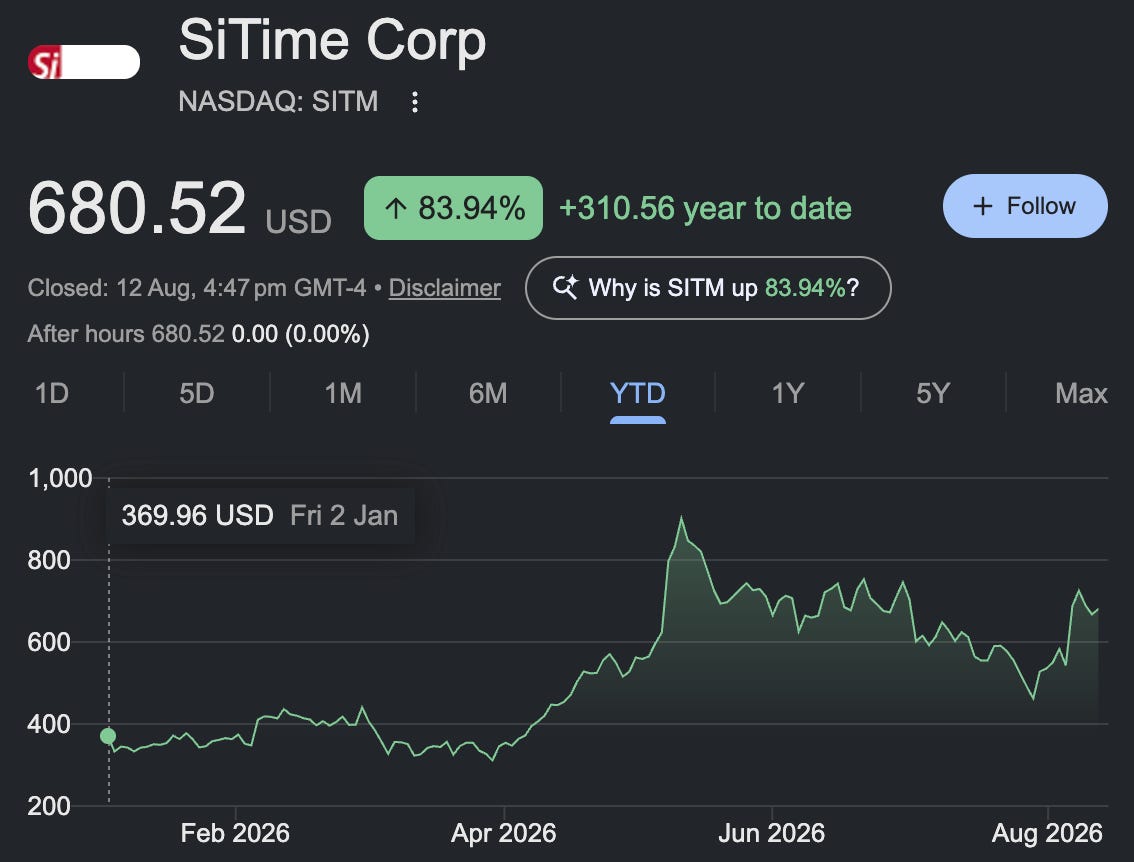
Given the (short-lived) success of the Kingboard Holdings idea, here is another hold co idea for value investors.
SiTime is the leader in micro-electro-mechanical system (MEMS) oscillators which have been replacing quartz oscillators in a variety of applications such as computing, consumer, networking, communications, automotive and industrial systems.
MEMS win on durability, shock resistance, and rapid configurability, while quartz crystals generally lead in pure phase noise, low jitter, and ultra-low power consumption. It’s a relatively small market which has been growing rapidly thanks to AI and datacenters, with the serviceable available market (SAM) quadrupling between 2019 and 2027, a CAGR of 27%.